

by Lachlan Turner
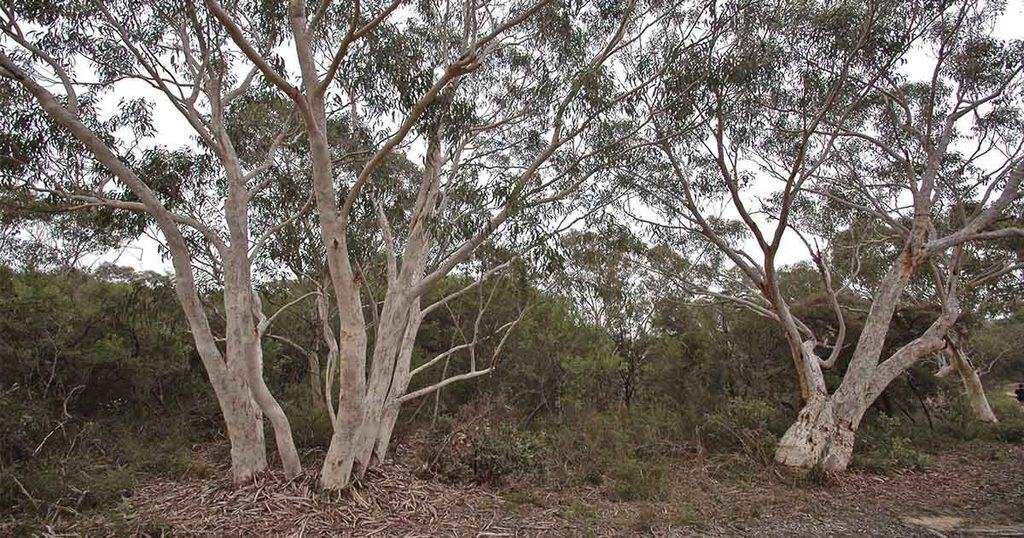
The name “Scribbly Gum” can refer to a number of eucalypts. The main owner of the name Scribbly Gum (Eucalyptus haemastoma) is possibly the best known example in our Hills District bushland. Its main habitat distribution is along the central NSW coastal plains mostly around the Sydney region.
This tree generally is not very tall with a number of short trunks growing from a single root system similar to the group of eucalypts known as mallee. It is characterised by those wriggly lines that appear on the bark, which are more noticeable after the tree has shed its bark.
These wandering lines are where the larvae of the Scribbly Gum Moth has burrowed just under the surface of the bark, finding a source of food in or under this top layer, leaving the characteristic wriggly trails on the surface.
The pale colour of the bark makes this tree stand out against the dull green colour of the adjacent heathland in which it often grows.


A closely related variety known as the Hard-leaved Scribbly Gum (Eucalyptus sclerophylla) exhibits similar bark colouration and typical scribbles. However it prefers a habitat with open woodland and forest, surviving on shallow to deep sandy soils. This more erect medium sized tree can grow up to 20 metres high.
Yet another similar variety found in the general region is the Narrow-leafed Scribbly Gum (Eucalyptus racemosa). It can grow to much larger proportions, is less mis-shapen and more erect when compared to the other two above. As its name implies, its leaves are much narrower than the others. This tree can survive quite well in poorer but moist sandstone soils.
This obvious infestation of insects does not appear to be detrimental to the welfare of the tree. These trees are useful habitat trees forming wildlife nesting hollows as they grow older.